Monday, July 7, 2014

The Tour de France, Leg 3

Cambridge Tour

There were predictions of 100,000 people flooding into the center of Cambridge for the start of the worlds biggest bicycle race.  I’d oscillated between walking into town to find a spot along the road, or driving out to the countryside to watch from a village. 

But, in the end, I opted for the in-town choice rather than the uncertain journey.

DSC07297 (1300x945)DSC07326 (962x1300)DSC07293 (1300x1018)

The race was at noon; scattered clumps of people were already walking past the college at 8:30.  I passed on breakfast, gathered my things, and started walking.  But by the time I hit the Fens, it was clear that few fools were out DSC07299 (1300x959)this early to compete for the best seats.  

The roads were blocked:   Workmen were still putting up barricades along the route, cones in neat rows, very polite police outnumbering spectators. 

But the city, at 9 am, was empty.

DSC07303 (1300x929) DSC07306 (1300x923)

I wandered over to Parkers Piece, where the race was going to start.  The TakeOff Area was ready, the giant screen TV glowing with test patterns, the restaurants starting to cook.  The Official Race Gear stand was open, with prices ranging from Gulp to Wow!.  The VIP sponsor areas were ready; there were lots of people taking pictures through the security wires.

DSC07321 (1300x1086) DSC07313 (1300x973)DSC07311 (1300x968)DSC07320 (1300x1126)

By 9:30, the first line of people had filled in along the start of the course.  I walked the route into town, faux-French signs everywhere.  It was time to claim a spot: I cut through the Market and around Great St. Mary’s Church.  And there, I parked: prime viewing, 9:30, with a coffee and a (large) bacon buddy.

It was a clear, cool morning, shadows creeping back across King’s Parade as the workers finished the racecourse. Vans selling official Race umbrellas and caps turned their loudspeakers to full volume, and the people purchased in £5 and £10 increments.

WP_20140707_013 (1300x734) DSC07338 (1300x974) WP_20140707_022 (938x1300)

At 10:30, people started to fill in the gaps as the roads filled with the Sponsor’s Parade: cars decorated with corporate characters throwing gifts to the crowd.  I saved my applause for Carrefour and Nijntje-bunnies.

WP_20140707_053 (1300x965)DSC07346-MOTIONWP_20140707_064 (1300x921)

By 11, the crowd was swelling and having fun.  Every police motorcycle was greeted by a sea of outstretched hands and high-fives.  A gendarmarie zipped past in a tiny police car, followed by an over-the-hill troupe of cyclists in race-yellow.  Two NHS Ambulance bikes staged an impromptu race in front of Kings college.  A student climbed the wall at Senate House and took a selfie atop it: two more joined him.

WP_20140707_081 (1300x734) WP_20140707_113 (542x483)DSC07361 (1300x974) WP_20140707_084 (1300x725)

A sleek car from a French magazine screeched to a halt and a newsman dressed as Sherlock Holms jumped out.  He scuttled back and forth, taking pictures of the wildly cheering crowd that was photographing him.

DSC07360 (1300x947) DSC07358 (1300x1182)

I wanted a cowbell.

The cue that the race had started would come as the the cheers filled Sidney Street behind me.  But the actual give-away was when the helicopters dropped low and TV crews pulled up on motorcycles.

The lead car rounded the turn from Trinity Street, the crowd roared, and the racers arrived.

Start of the Tour de France

It was worth every minute of the three hour wait.

DSC07377 (946x1300) DSC07373 (1300x955) DSC07375 (975x1300)DSC07368 (1300x958) DSC07376 (1300x973)

More photos on my Flickr page.

Labels: ,

Monday, July 12, 2010

So, now life gets back to normal

DSC01011 The thunderclouds rolled in from the south this morning, bringing a brief burst of rain and wind that scattered chairs and pedestrians.  The temperatures moderated, the breeze shifted, and the sticky debris of a night’s celebrations washed from the cobblestones.

But it was fun while it lasted, wasn’t it?

‘Like the Billy Joel song, yesterday evening saw “the cowboys and their kin, like the sea come rolling in”, although it was a tide of orange-clad fans and families.

DSC00956 Stitch DSC00962

By game time, the Vrijthof Square was filled, nervous anticipation mingling with the haze of pot smoke.  The anthem was sung, the crowd roared and waved flags and horns, the ball was put in play.

 DSC00970 Stitch

I wandered back to the waterfront to watch with friends at the apartment.  The large monitors along the street blared the game and the cheering was continuous outside the windows.  Curiously, our television connection lagged theirs by about 3 seconds:  it took the edge off every penalty kick to hear the crowd groan or cheer moments ahead of actually seeing the play.

DSC00987DSC00999

I thought that the Dutch were scrappy and energized, although the foreign commentators were uniformly critical of the Netherlands’ style and aggressiveness. 'I think that, as Americans, we look for different things in a game: a strong offense, a high score, a win.  Despite the loss, the Dutch took it all philosophically: there weren’t a lot of sad faces along the streets afterwards and the party flowed on into the wee hours.  DSC01005There was a rumor that Andre Rieu was going to make a surprise appearance to cheer up the crowd at the Vrijthof after the game, but I don’t know if he made it.

And, today, it’s all just memory: the flags are coming down and life is getting back to normal.

…and there hasn’t been a vuvuzela squawk all morning.

Labels: , ,

Sunday, July 11, 2010

Night of the Vuvuzela (not the waltz)

vuvuzela I returned to Maasstricht late last night; the sky was lit up with thunderstorms and the midnight streets were filled with drenched refugees from the annual Andre Rieu concert week in the Vrijthof Square.  Yet, even through the classical garb, soggy spirits, and tropical humidity, the vuvuzela rang out over the city.

The horn, a South African instrument, has become a big symbol for this year’s World Cup match (okay, still a step behind Beesie), With the finals upon us in a few hours, the horns are everywhere.  As the Dutch helpfully describe them:

Een vuvuzela is een Zuid-Afrikaans blaasinstrument van hout of plastic, dat een enkele toon produceert. Het blaasinstrument is voornamelijk bekend in landen gelegen in het zuiden van Afrika. De hoorn is circa 62 cm lang en door op een bepaalde manier te blazen komt er een geluid van circa 130 decibel uit.

Even without understanding much Dutch, you get the impression that it is a) long, and b) loud.  They sound a bit like ragged alpine horns, usually accompanied by shouting and singing.  It all makes  a wonderful blend of street noise that goes well into the evening.  This evening, especially, will be frenzied (there are worries in Amsterdam that vuvuzela-tooting hoards will stomp over the roofs of the houseboats, with attendant risks of capsizing and sinking).

Andre Rieu moved the stately evening of waltzes out of the Vrijthof Square this afternoon, taking up residence in the MECC Convention center outside town. Both the match and the extreme heat (hitte); have been a challenge: there will be a live connection back to the Vrijthof, split-screen with the games.

image

This is no mean trick: his stage is the size of a Greek monument, with multiple levels and archways to support the dancers and musicians.  This is what it looks like, and the square they are vacating for tonight’s game.

maastricht_2005__22__eae7b_1600x1200

At any rate, I’ll be there, just hours from now.  ‘Fingers crossed, no matter what Paul the Octopus and Mani the Parakeet predict…

Labels: , ,

Friday, February 26, 2010

Watching the Olympics

Kramer

I’ve been enjoying the Dutch Olympic coverage on Nederland 1 this week; they do a pretty good job of sticking with events and summarizing results, although the commercial breaks feel long and repetitive.   In Seattle, I used to watch the Canadian coverage because they focused more on events than on manufactured backstory; I like that in the local coverage as well.

The ski-jumping was good, the ice-dancing finally seems to be maturing, I’m holding my breath against someone sustaining a really serious injury in the aerials, and I always enjoy the women’s curling.

A friend suggested that it’s a sure sign of old age when you start thinking the women’s curlers are cuter than the downhill skiers.  But, in my defense, there is the video by the Swedish women’s curling team to consider.

But most of the tweets and e-mails back and forth with folks in the US have been about Sven Kramer.

There was a lot of interest in his early, record-breaking speed skating win in the 5000m race, in his six-foot-plus height, and in his infamous interview with a US reporter (“Are you stupid?”), which got a lot of play on YouTube (now removed at the request of  the IOC).   Supplemental to that last story, I send my personal thanks to the Guardian for asking whether we should be debating the ignorance of American TV reporters or the rudeness of Dutch speed skaters (and for noting that it’s a question of postmodern philosophy). 

But my lines really lit up after Sven’s disqualification in the 10000m race.   It was heartbreaking to see: the coach absolutely and immediately realized his mistake and what it meant, and it was a tragedy for Kramer.I’m glad that Kramer was able to be gracious about it in the end, but the conversations between the two of them afterwards must have been terrible for both.  A bicycling coach blogged a good perspective on it, but I still would have found it unforgivable on a professional level.

“How is this possible!" was De Telegraaf’s headline.

“I wanted to coach him too perfectly,” offered the coach.

Labels:

Thursday, August 14, 2008

Bits and bobs before the sun rises

I'm up early this morning; it's only about 3:30 here in the room outside Minneapolis.  Normally I take a couple of Melatonin tabs a half hour before bed and it helps me to sleep through the first couple of nights.  Unfortunately, I didn't pack it along this time, so I'm going to have to rotate things more slowly this trip. 

Nonetheless, it's quiet outside (the thunderstorms pass through around sunset) and, with hours until the day's interviews, I'll catch up on a few coming-to-America thoughts for mid-week.

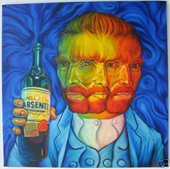
image A friend asked if I could bring back a small bottle of Absinthe, the one with the little spoon.  The local Gall & Gall had a cute package with van Gogh on the outside for 11 euro, and I tucked it into a corner of my suitcase without much thought.

I named it on my declaration card, and was rewarded with dripping red scrawl from the inspector and a quick trip to the agricultural desk.  They gave me a copy of the Know Before You Go booklet "The importtion of absinthe and any other liquors that contain artemista absinthium is prohibited" and confiscated the bottle.  We spent a half hour filling out confiscation and surrender of goods forms, the agent reassuring me that I would not face fines or court appearances this time.

'yike, and damn.

I'm noticing that procedures at the US border continue to evolve: TSA and Homeland Security must still be fine-tuning existing procedures and adding new ones.  Yesterday, they announced that they would no longer track people who failed to have proper ID at checkpoints, instead limiting entries to people without ID who then give a false name to screeners.  I've noticed that we have to thread a phalanx of agents along the corridor ahead of passport control now: they seem to stop about 10% of people for a conversation and inspection of documents.  Patrols around baggage claim have also been stepped up, and people texting or talking on cell phones are getting questions.

ESTA (2)

A new declarations program is going into effect: the Electronic System for Travel Authorization (ESTA).  This system replaces the current paper declaration forms with an on-line pre-declaration, and becomes mandatory at the first of next year.  You can fill in the forms voluntarily now at their web site, and approved registrations are good for two years.  There is no cost: a friend tried to find the site and ended up somewhere else, being asked for payment for processing.

The interviews are going well: I take these as opportunities to understand where I can contribute and to connect across the table, rather than as pitches and challenges.  In that spirit, they've been enjoyable.

After yesterday's round, I went to the local health club to unwind on a bike, and was stuck by how noisy it was in comparison to Dutch clubs.  There is lots more calling across the room and talking between bikes, and a bank of TV monitors, all tuned to different channels, chattering under it all.

This seems to hold more generally: the hotel has background music and the television on all the time; the shopping centers all have ambient music.  Restaurants pipe mood music into the inside and outside (terrace) areas.

Why?  It's not common in Europe: is it done here to promote comfort, to relieve loneliness, to promote sales?

Suburban Minneapolis is a land of enormously broad streets and widely spaced detached businesses.  This makes for vast distances between doorways when I go shopping for the essentials that I can't get in the Netherlands. It's just not possible to walk from store to store: each must be a separate driving destination, increasing the time, cost, and hassle of running errands.

DSC09661 DSC09664

Like Las Vegas casinos, I suppose that merchants benefit when its hard for shoppers to go from one store to another.  Once it becomes more of a hassle to drive down the road to see more of the same, rather than to settle for what the current store offers, then a sale is made.

DSC09676 DSC09670

I think that this is what led to the evolution of one-stop centers like WalMart and Target, and their cousins the strip malls: essentially multiple shops gathered into departments under one roof. They become more attractive destinations as they enclose more departments, so Target begets SuperTarget: oversized and out of scale with surrounding homes. It forces retail and residential areas to become clustered and segregated, further increasing dependence on the car and the necessity for roads and parking.  It's a viscous cycle.

 image image

Yesterday's Yngling races (pix from sailing.org) were postponed due to lack of wind and visibility, but will resume Friday.  The standings: The Dutch Yngling women's team is still in second, equally behind the British and ahead of the United States.  '

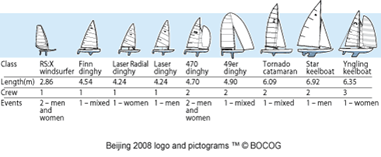
Finally, a quick refresher on the Olympic boat classes:

image

Okay, sun's up...back to the street and on to the next interview...

Labels: , , , ,

Saturday, August 9, 2008

Dutch sailing skills

sailing

I was watching the women's sailing competition today from the Qingdao Olympic Sailing Center, located on the Yellow Sea about 500 km SE of Beijing. The Sailing Center is built on an old shipyard of the port, close to the business center of the city, and the events take place in Fushan Bay against the backdrop of the skyscrapers.

Qingdao Olympic Sailing Center

The women race in 3-person teams in a standardized Yngling keelboat, just over 6 meters long and weighing 645 kg fully crewed.the spinnakers have national flags which makes it easy to spot the teams and mark everyone's progress.

When I tuned in, the 2nd heat racers were crowded around the second mark: it was hard to tell who was ahead as everyone jostled for position and wind.

Usually, sailboat races feel predictable: one-class boats are evenly matched, the wind is pretty consistent across competitors, and, with evenly matched crews, the boat order doesn't change much over the course of a race unless there is an equipment failure or an error. So the team that is ahead usually seems to stay ahead. No sign of the Dutch team, though.

But, as the boats came out of the last mark, the coverage suddenly shifted to show the Dutch women's team sailing lightly across the finish line. The final statistics show that they were over a minute ahead of all three of the next finishers, who were bunched within 25 seconds of one another. This included the favored British and American teams.

The detailed statistics were even more remarkable. On the 'windward-leeward' course (the race was limited to going back and forth between the first and fourth of the four course markers), the Dutch women were ahead by 16 seconds at the first mark, a minute at the fourth, and over a minute and a half back at the first, among a field of 15 boats. The wind was light, only 6 knots, so it doesn't seem like a matter of catching the lucky puff of air at the right time (although, this evening, competitors are saying that is exactly what is going on).

The sailing press has been talking about the impact of technology on the races. There had been rumors that the US and Dutch teams were experimenting with alternative sail designs in the days leading up to the events, when it was apparent that winds could be light. It became controversial within the Tornado class boats. About.com had a good detail about the specific sail modifications that the team was attempting, and the risks that they were taking if the winds freshened. It all leads me to wonder if sail tuning might also be a factor, along with excellent training and tactics.

It will be interesting to see how it holds up in tomorrow's 3rd and 4th rounds, but it was nice to see the Netherlands team off to a strong start.

Photo credits Beijing-2008 and sailr.com sailing news aggregator

Labels: ,