Saturday, February 23, 2013

Italian alleyways

I used to really key in on the Italian countryside, then the charming towns that cap hills like snow and tumble down valleys to the sea. 

And I still do, but increasingly I look for the jumbled alleys and local faces, the colored shadows and earnest conversations. 

And Sicily was filled with them.

      DSC06202 

And, after exploring the alleyways, it’s time to retreat to the cellars.


Labels:

Thursday, February 21, 2013

Sicilian impressions

I have admit that Sicily was a whim.  There were cheap airfares straddling the route between Maastricht and Stansted, the weather promised to be warm(ish), and I was ready for a long weekend free of Boards and Contracts. Living in Europe means Doing Europe when the opportunity presents, spending a bit of treasure on Experiences rather than Things in pursuit of happiness.

Sicily delivers.

The countryside is incredibly varied, from sparkling Mediterranean shores to cloudy snowblown mountain peaks.  It’s not a large island and the motorways that cross the interior put the entire province within half a day’s drive.  Coastal roads take longer, but I’d be slowing down anyway just to admire the views or to pull off into a village

Motorists are something else: one guidebook described them as driving like ‘dogs on drugs’.  That’s kind.

Signage is somewhere between intermittent and misleading: a sequence of pointers to a town suddenly end miles short of the destination, others lead to closed roads.  I don’t know if Sicily never had good signage, or they let the labeling decay when car navigation arrived.

Not that TomTom is much better: I found myself perched at the top of a flight of stairs leading down a village street one hapless night.

Sicily looks like a place that should be heavily forested, but there are none.  Articles suggest that when the Romans converted the island to agriculture, the rainfall declined and the rivers dried.  The potential for desertification seems real, and is a major  concern for Sicily’s future.

Today’s problem, though, is Garbage.  For some reason, the locals throw it *everywhere*.  It lies in haps along the roads, piles in drifts at rest stops, crowds the alleys and fences.  It is absolutely beyond me why people allow this, although I suppose that once some do, then everyone will.

There is also a creeping blight of unfinished cement buildings, just columns ad floors with no further work ongoing, and the “Spanish disease” of white plastic greenhouses force-germinating tomatoes and fruits.

The people are incredibly friendly, quick with a smile, a welcome, a recommendation, or a story.  English was generally good,  better than most of the rest of Italy, never a problem in hotels, only occasionally difficult in restaurants.  People are masterful line jumpers, who can advance through a queue at twice the rate of anyone else. 

Food was outstanding: local cuisine leans heavily towards hearty fish dishes, whether salads, appetizers, or mains. Wines were full and fruity, very cherry: the house wines were almost always excellent.  Prices were moderate, generally about 20-25 euro for sit-down lunch or dinner.

A good introduction to both the culture and food of Sicily is “Sicily Unpacked”, a 3-part BBC special with British art critic Andrew Graham-Dixon and Italian chef Giorgio Locate.  (I would much rather be traveling with Giorgio than Graham).

Pictures up shortly at my Flickr site.

Labels:

Friday, February 15, 2013

How sunrise should look every morning

DSC06072Looking south across Taormina to Mt. Etna, smoking ahead of it’s recent eruption. 

The current view, above, and my morning’s-eye  view a week ago, below.

  Etna erupting

Labels:

Friday, December 5, 2008

Hang time around Rome

DSC03524  The conference center’s across town from the apartment’s neighborhood, which made for good opportunities to criss-cross the city a couple of times each day.  Since the traffic is uniformly terrible, there’s always time for looking and thinking…

I was surprised by the near total lack of Christmas decorations.  The apartment agent said that the Italians don’t do a lot of displays anyway, and the financial meltdown had taken away the shoppers. ‘hard to believe, but from St. Peters to the Coliseum, Rome was largely dark.

DSC03600 Stitch

Rome does, however, have an amazing sense of style, everywhere, and on everyone.

DSC03690 Rome is filled with scooters.  They snake between the cars, bunch ahead at lights, and demand lanes between cars where they can stream ahead.  It’s probably the most efficient way to get around the city, and it seems like a great opportunity for electric or hybrid models that would minimize pollution.  I never saw one, though.

DSC03673 There is a sense of history everywhere, stone structures and crumbling walls that always remind me of the days of empire.  I wonder about the everyday Italian’s perspective on their history: is it just a bit of overlooked background, a source of pride, a golden age to feel wistful about.  Many European countries had their century in the sun, long ago passed.  Rome’s was particularly strong and influential, though: do they feel inspired or intimidated by the constant reminders?

DSC03706 Stitch

The food in Rome is absolutely outstanding at every turn.  From little corner spots where you get a fresh-cut slice of pizza to upscale venues filled with pictures of the owner posed with rich and famous visitors, every meal is adventure and delight.  I’m convinced that the Italians don’t send the best stuff out of the country: the wines and pastas are wonderful.  I asked for a recommendation of Grappa at a wine bar one night, and they pulled a 20-year old bottle out for us to try.  It was like velvet: a totally unique experience.

DSC03693 DSC03677

The flight back to Einhoven on Friday via Ryanair was packed with Italian students.  Every row, every seat, as though it were spring break.  It looked like a football or festival crowd, but I didn’t know of any events happening in the vicinity.  The Dutch border agents told me that this was the normal type and flow of tourists coming up for a party weekend in Amsterdam.  It’s the first time that I’d really encountered the ‘trade washing north: I understand why the Dutch city fathers are trying to think of practical ways to dampen it down.

Labels: ,

Thursday, December 4, 2008

Starling roost at sunset (video)

I wanted to get some good pictures back onto the city of Rome from the Ponte Sant' Angelo bridge on Thursday evening after the conference.  A huge flock of starlings gathered east of the bridge, over the trees, and started executing a “Starling roost”, forming fluid patterns of shadow and shape against the evening sky.  It’s an amazing sight, and played out over the river until the light had gone.

The pictures can’t do it justice, but the video (now posted on YouTube and linked, below) does.

DSC03653 DSC03662

DSC03661 DSC03666

Labels: , ,

Wednesday, December 3, 2008

Hanging out in Rome

icd The XIII International Symposium on Progress in Clinical Pacing is meeting in Rome this week, a gathering of cardiologists and researchers interested in electrical dysfunction and therapy in the heart.  The general public sees pacemakers as “old technology”, but there are a surprising number open clinical questions and new research findings that keep the proceedings lively.  From my perspective, it’s also a good chance to catch up on new devices and technologies, both well-understood ones like implanted defibrillators and resynchronization generators, but also monitoring devices for acute myocardial infarction (my specialty).

And, its a nice chance to visit a wonderful city.  I tried a different approach this visit, taking an apartment for four days instead of a hotel room. It was simple: I met the agent, got a quick orientation, gave her cash, received the keys, and I was flying solo.  It’s been a really good change: the apartment is beautiful, very stylish and modern.  No wifi connection, but an Internet cafe around the corner, next to a delightful pastry shoppe that’s kept my breakfasts happy.  The heating is a bit intense, and it’s hard to find a cab in the morning, but those are really minor issues.  The place runs about 2/3 the cost of a hotel,and is really worth considering (thanks, FriendlyRentals!)

DSC03488 DSC03518

I’m living in the Trastavere, a neighborhood along the west bank of the Tiber towards the south part of the city.  It’s a warren of narrow cobbled streets filled with little restaurants and bars, a bit rough around the edges and totally un-drivable, but a real slice of life.  I am starting to take a deep liking to places with lively street life, little cafe’s, eclectic residents.  The best restaurants are scarcely noticeable from the street, but are warm and filled with locals.  The food is everywhere outstanding and relatively cheap: paper on the tables and kitchen just a doorway away from the patrons with the owner’s daughter serving.  It’s empty until 8:30, when the crowds suddenly flow in, greeting, kissing, gossiping, moving tables to accommodate groups.  The plates of food and bottles of drink fly back and forth without much glance at a menu, and payment is a cash affair at the end.  Totally great.

DSC03475DSC03473

DSC03699DSC03684

Labels:

Friday, September 26, 2008

Amalfi and Cinque Terre

  Well, 'back among the Internet-alive again.  I'm still out of the country, holed up in Switzerland for a day of break before the final drive back to the Netherlands.  The Italians make it impossible to access the Internet in many places: there is an anti-terrorism law on the books that requires passport-registration in order to use e-mail and fax.  It's ironic when contrasted to the lax state of Italian border security: I am always just waved through at the Swiss border with only a cursory glance.  (The Germans, in contrast, take their responsibilities to safeguard the EU frontier at Switzerland very seriously.)

'lots to catch up on, of course, but this will be quick today.

  It's been a long trip: from Arnhem through Paris and Lyon in a big arc down into Italy through the Mt. Blanc tunnel.  Then a sprint across northern Italy to Bologna for the Computers in Cardiology conference.  After a couple of wonderful days there, I joined researchers for a satellite conference in the small hill town of Bertinoro for a few more days, getting a side trip to see the mosaics at Ravenna.  Then a two-day weekend drive through Umbria, stopping in Assisi and Spoleto on the way to Naples for a Monday meeting with physicians.  A half-day in Pompeii, a half day out on Capri, and a half-day driving the Amalfi coast road rendered a feeling for that part of Italy, then it was a sprint back north.  Again in Umbria for an evening stopover at a favored hotel and a day and a night in Cinque Terre, just south of Genoa.  The miles were starting to wear thin, so Grindelwald, with the mists even now lifting over the Eiger, makes a wonderful waypoint before driving up into Germany and home.

I was hesitating to visit Cinque Terre: there have been so many wonderful pictures and descriptions by other expat bloggers that it felt like someplace that I should see, but at the same time, it sounded a lot like the Amalfi coast and I was starting to get travel-weary.

In the end, though, I'm glad that I did both, and both are worth seeing.

Similarities: Amalfi and Cinque Terre are both stunningly beautiful areas to visit, rugged green coastal mountains that plunge straight into the sea along the southwest and northwest coasts of Italy, respectively.  Each has colorful fishing villages that nestle in the valleys between the teeth of the cliffs, and winding roads above that give breathtaking views of the scenery from on high before plunging into the valleys.  Each is well worth a full day of exploration.

DIfferences:  Amalfi is much longer: almost 50 km vs. perhaps 10 km at Cinque Terre.  The roads are much more difficult along the Amalfi coast: they are narrower and crowded with tour busses and trucks that force endless negotiation for right-of-way against cliff edges and walls.  However, the roads do rise and fall to connect the villages: in Cinque Terre, the main road stays high on the cliffs and occasional side roads dip to the seaside villages.  Even those roads stop short of the towns, requiring a 10-15 minute hike to descent the last bit.  The trains and boats are probably a better bet to get between towns in Cinque Terre than a car, while a tour bus might be preferable at Amalfi.

Because of the number of tours, Amalfi tends to have an older crowd, more British and German groups.  Cinque Terre has amazing hiking that attracts a more active British and American group decked out with top-line hiking sticks and shoes (ironic since the footpath is pretty well maintained with steps and paving).  The towns tend to be more tourist-oriented in Amalfi; Cinque Terre is a bit more weathered and working.

In all, forced to choose, I would give the nod to Cinque Terre: it is more compact, has a more 'authentic' feel, and better pricing.  But if you are in Naples and have time for a slow drive, Amalfi is a good one.

A few contrasting pictures:

Amalfi:

Amalfi Coast 3

Amalfi Coast 4 Amalfi Coast 1

Amalfi Coast 2 

Cinque Terre:

11 Cinque Terre 018 

 11 Cinque Terre 038 Stitch

 11 Cinque Terre 014  11 Cinque Terre 095

Labels: , ,

Saturday, June 21, 2008

Nine Lives video through Rome

DSC08646 'Trying something different today: a bit of an exploration of media sharing.

William and I took a long video capture with my Sony Cybershot point-and-shoot camera while we drove on the scooter through the center of Rome. It's about eight minutes long, and is a bit bumpy because of the scooter's engine vibrations and the cobblestones. The audio is live, but mostly wind noises and the occasional bit of back-seat driving directions.

Frankly, I was hanging on tight with knees and one hand, holding the camera over William's shoulder with the other, so there isn't much creativity involved: we just wanted to see how it would come out.

The route starts near the Coliseum along the Via del Fori Imperiali that parallels the Roman Forum, then around the Vittoriano museum, and into Vittorio Emanuele street, headed west. Eventually, we cross the Tiber and into the v.della Conciliazione street, the main way into the Vatican, where we end.

Technically, it's raw footage except for adding a title with MovieMaker 2.1, and saving it in a .WMV format which decreased the size by 2/3. I experimented with saving in different formats using Replay Converter, but most seemed to really degrade the picture quality. The upload to YouTube and embed using Windows Live Writer was pretty straightforward, just following the prompts. In the future, I'd probably fiddle with getting the audio and stability better, and with some geotagging prior to uploading.

Start to end, it's a first try, so don't expect much, but it hopefully works and gives some idea of this means of travel.

Labels: , , ,

Thursday, June 19, 2008

Seeing Rome on two wheels and nine lives

DSC08359 Stitch <Sigh>  'really in a mood to write a bit on what's been happening at work the past month since the transfer and layoff was announced, but things are still up in the air.  Negotiations are ongoing regarding advice, settlements, and pensions, and it needs to conclude without my two cents here.  I have opinions, though.

So, for now, continuing in Rome...

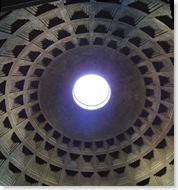
Today we decided to take the day for historic Rome according to the Michelin guide.

I usually prefer Frommers, but their book has become too large to carry and consult.  My friends prefer Lonely Planet, but I've become skeptical since reading Thomas Kohnstamm’s "Do Travel Writers Go To Hell?", detailing the ways that he cut corners in compiling advice.  Even though his experiences are probably universal, the fact that they happened at a particular company is warning I can't ignore.

This is my first time trying the green book: it seems to have better reviews of architecture and history, but it's very difficult to find things inside of it.  Places are arranged by neighborhood, which is almost impossible to use quickly when you don't know (and can't spell) where things are.  The "One day" tour also covers a lot of ground: it became clear when we started at 8:30 and had only hit the Coliseum and the Palatine Hill by noon that we needed to find an alternative to walking between venues (NOT cutting time from seeing the venues themselves...).

The guide made the suggestion that scooter rentals are easy and cheap and, indeed, they are.  30 euro for a full day, 18 year minimum age.

"Do you know how to ride, sir? That's fine, here are the keys!" 

"By the way, our scooters are out, so we'll upgrade you to a full 125 cc bike for only 40 euros total.  Be back by seven and wear a helmet please."

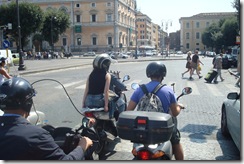
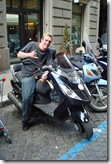
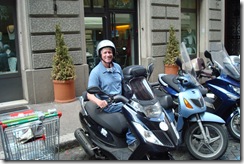
So it was, with my son at the controls and me on the back, that we launched into Rome's traffic on a shiny black Dink 125.  Pretty basic transportation, but also pretty powerful for our level of experience.  It's fully capable of getting up to 80 km/hr without much effort, and I found myself perched up above most of the compact cars pressing in around us.
DSC08335 DSC08334

Still, it was a fun day, and a totally unique experience in Rome.

Early on, we found that traffic in Rome moves briskly, ignores lane markers, and, indeed, ignores most traffic signage (including stop signs, stop lights, do-not-enter signs, and bus/taxi lane markers).  Not that things are that well marked to begin with: routes to major sights are poorly marked, bus lanes spring out of nowhere, and roads plunge into tunnels and traffic circles without guidance or warning.  The carabiniere simply wait on the sidelines, everywhere, to clean up if something happens.

In this circumstance, I was actually glad that William was driving.  I said the other night that young people have confidence in themselves, and it gave him just enough edge that he could sort out situations and (generally) handle them properly, where I would have analyzed and hesitated (and crashed).  I could apply my confidence to navigation and map-reading (and girl-watching).
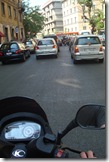
DSC08395DSC08405

We also found that the added speed did not simply get us from place to place faster: it actually got us lost over wider areas.  Arno Penzias made the same observation once about faster computers.  I would look at the map and say, okay, if we are at the Spanish Steps and want to get to the Trevi Fountain, it's easy: down a block, right, forward two blocks, left, and one kilometer ahead to the square.  The problem was that Rome is filled with one-way streets, so the end of the block would have a blue arrow pointing left, then we would follow the flow for a half kilometer searching in vain for a street right without a do-not-enter.  Then, finding one, we would end up an a series of one-way handoffs and lane splits until I was so turned around that we had to pull over and start again.

At least parking was a snap: there are blue-line areas for bikes to park everywhere, and nobody seemed to want money.

So, we really covered everything we wanted to see, had a lot of serendipitous drops into neighborhoods that we wouldn't have entered otherwise, kept the carbon footprint low, and survived to toast the tale at the end of the day.  

DSC08409

Labels: ,