Thursday, September 12, 2013

My day in Dutch court (1)

DSC00034 (1200x899)I suppose that it’s something of a milestone as an expat to be bringing an action in Dutch court against an American company.  Not what I wanted to be doing, but as a business owner, I have to run my business.

‘even if it means a day in the Rechtbank.

A bit of background: My company, Stone Bridge Biomedical BV, has been directing work for a US company among Dutch and US subcontractors.  When the US company ran out of money, we waited a month, then suspended work here.  Still, there were lagging costs in shutting everyone down that now total over half a million dollars.  I’ve used my company’s resources and took additional bridge loans to cover the bills, but after six months with no resolution have needed to initiate collection proceedings in the Netherlands.

Hans BosThe Writ of Summons went out in August, and the court date was today: I retained an Amsterdam attorney, Hans Bos, recommended by my accountants.  The US folks announced that they would appear in Limburg to contest the action, so the work and expenses ratcheted up for us both.  Hans and I spent the week combing emails and documents to prepare simple Pleitnotities and Exhibits for the court, anticipating arguments that the other side could make.

The courthouse lies just outside of Maastricht: I put on my suit, rattled over on my bike, and passed through security for the 11:30 am hearing.  There is a large central atrium with benches where clients sit with their lawyers, conferring.  Dozens of Zittenzaal (hearing rooms) surround the space, incongruously adorned with original art of the King and Queen (for sale).  Hans arrived and checked out his robe from the desk and asked about my translator.  Dutch lawyers Dutch lawyerappear in court wearing a simple black robe with a band, a precursor of the necktie consisting of two pleated white panels.  The judge wears a similar band, but over a fancier robe.

We reviewed the pleading and exhibits, Hans introduced himself to the opposing counsel, and my translator arrived (in a black t-shirt).  We reviewed court etiquette (Stay seated, address the judge as “Your Honor”, keep answers short and to the point), the order of events and circumstances where I could confer with Hans or needed to answer the judge directly.  It all seemed similar to US procedures (consistent with traffic court and television dramas, at least).

At 11:45, they announced our case and room and off we went.

Labels: ,

Saturday, June 5, 2010

About the realty office…

DSC08345 When I need to find a new residence in the Netherlands, I make the rounds of the local realty offices to see what is offered te huur (for rent) and te koop (for sale) in their windows.  (I also cruise around the streets looking for rental signs in windows, but that is less efficient).  When something looks good, I make arrangements with the agent to see the property; they also relay offers to the landlord, handle the paperwork, and oversee the move-in.  For this, they collect one month’s rent as their fee, about 1000 euros.

The fee is a bit of an irritant, since they don’t seem to do very much for it.  Appointments to see a property take half an hour, and paper signing is brief and straightforward.  But it’s the cost of doing business in Maastricht, and there doesn’t seem to be a way around it.

But in return for that fee, I do expect them to do their job well.

This time, things didn’t go so smoothly.  The apartment is above a vacant store (soon to be filled with a restaurant), and the stairway empties directly into the construction area.  The landlord promised to redirect the stairwell, but had heart surgery in April and the work lapsed.

I dropped by periodically to check on progress, advising the agent of the ongoing problems, but nothing changed.  Finally, moving day came.  I found that my agent had gone on a six-week vacation without making the handoff to another agent.  The rental agreements couldn’t be found; the keys went missing.  The new agent couldn’t get the keys to work; the stairwell was blocked by construction, there was garbage from the workmen piled against the apartment door.  The hot water was a trickle, the doorbell didn’t work, the mailbox went missing, the final cleaning hadn’t been done, and there was a thin layer of construction dust over everything.

I have moved three times in the Netherlands, and this was just bad.  The realty office owner said that the original agent had a migraine that prevented the handoff, that the landlord wasn’t answering the phone, that there were a dozen other excuses.  I was unwavering: with their fee comes accountability for managing the transaction.  It is not my responsibility to be checking the apartment and advising them, nor to be chasing down the landlord.  I refused to pay them until the situation was corrected (I did pay the security deposit and first months rent).

Within a day, workmen were back out front, a plumber stopped by to work the water and replace the heater, the owner dropped in to assure me that things would be taken care of, the agency paid for a cleaning.  I feel like things will be right within a few weeks and then can finish negotiating a properly reduced fee with the realtor.  But the lesson is to stand up for yourself, take pictures, and leverage your payments into actions when something needs fixing.

Labels: , ,

Wednesday, April 8, 2009

The expat’s dilemma

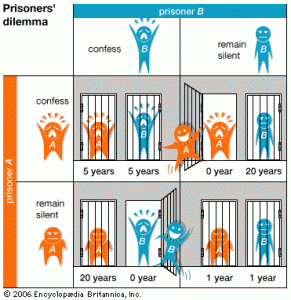
The Prisoner’s Dilemma is a simple social paradox: two prisoners are isolated from one another and each is told that if they cooperate and the other doesn’t, they will be released.  However, if they remain silent and the other implicates them, then they will receive a harsher sentence.  If neither confesses, both will get the minimum sentence, while if both confess, they will receive an intermediate term.  The paradox is that the optimal strategy for each player is to betray the other, leading to a poor outcome for both.

A variation of this game is to play it repeatedly, giving each player the opportunity to punish the other for non-cooperative play.  Game theorists have shown that the optimal strategy for each player becomes ‘tit for tat’": initially refusing to betray the other, then responding in kind to the other player’s action from the previous turn.  Thus, despite the incentive to defect on each round, players tend to cooperate, building trust and achieving a better overall outcome.

I generally apply this strategy in everyday social and business life, assuming the best in others and trusting their actions unless they betray me.  You get what you expect from people.

Occasionally, though, I’ve found that this strategy spins out of control in cross cultural situations.

For example, I may ask a Brit-friend if they’d like some coffee.  “I don’t mind", they might reply, a vaguely negative sentiment in US-speak. So I give them a soda instead.  They gauge me to be an unreliable drink-fetcher, and go get their own coffee.  I’m insulted and mutter something about ungrateful inconsistency.  Merriment ensues.

We’re both practicing ‘tit-for-tat’, but the iterative connection between cause and effect breaks down because of cross-cultural misinterpretations.  There are any number of everyday situations where one person may innocently come across as rude or insensitive, leading another to erroneously respond badly. Or, in game-theory language,

“A one-time, single-bit error in either player's interpretation of events can lead to an unending "death spiral", in which each side perceives itself as preferring to cooperate, if only the other side would. But each feels forced into repeatedly punishing an opponent who continues to attack despite being punished in every cycle. Both sides come to think of themselves as innocent and acting in self-defense, and their opponent as either evil or too stupid to learn to cooperate.” [1]

Sound familiar?  I suspect that this is very common in expatriate social situations.

A neighbor waited for me to introduce myself.  I thought their silence was rude and unwelcoming, and so avoided them.

I didn’t present an incentive appropriately to an employee, which they interpreted as intentional lack of respect.  So they raise the issue with HR, landing us both in trouble.

Best intentions, badly communicated, can lead to cascades of tit for tat.  How to avoid the trap?

“Tit for Tat with forgiveness" is always good: keep responses proportional and be quick to offer an olive branch.

“Tit for two tats” is advocated by game theorists as a way of promoting tolerance.

“Good humor”, says I, along with a willingness to call a time-out, have a sit-down conversation, and sort out the problem together. Sometimes it takes a mediator to get started, but I always like to make opportunities to unwind situations that, all too often for expats, turn out to be based on  simple misunderstandings.

Labels: ,

Wednesday, March 25, 2009

The distance among close relatives

Evan Penny Distorted faceI was talking with a northern-Dutch friend the other day about North/South differences in the Netherlands.

The dividing line here is the Grote Rivieren, the three large rivers cutting across the middle of the country and separating the more industrial, Calvinist north from the more agrarian Catholic south.  As in the US, its a divide of both language and temperament; curiously, the qualities are geographically reversed in both countries as compared to the UK.

And, in all three instances, the north and the south glare at each other across their geographic divide.

I was surprised by stories of how a shopkeeper in Maastricht might delay service if he recognized a northern accent, or how locals seemed to make a deliberate effort to elongate the differences in southern pronunciation.  For such a small country, and with so many similarities, wouldn’t they tend to get along better?

DSC01895 The whole situation reminded me of the perceptual distances I learned in art class.  My early efforts at life drawing were really just sticks and lines (upper right), good gesture drawings, but no Matisse.  As things improved (lower right) I was able to capture more character, but the faces sometimes looked bizarre and troubling.  Dave - Negative FaceMy instructor told me that there’s a point where things are close enough that they are seen as a distortion of the familiar, rather than unfamiliar, and therefore uncomfortable to look at.  The way people react to chimps, puppets, and “The Polar Express” are all examples of the phenomena.  In art, it suggests that you’re getting close to getting it right.

I wonder if there is a similar thing going on North / South.  While we are different from the French or the Japanese, maybe we see contrasts with our own countrymen as self-distortions.  The differences between Arnhem and Maastricht don’t seem very pronounced to me as an outsider, but it seems like people are very attuned to it here.

Wall sculptures by Evan Penny

Labels:

Sunday, February 22, 2009

Scenes from Carnivale Saturday

I’m convinced that everyone living in the Netherlands keeps a funny hat and an elaborate costume in the closet for special occasions.  The costumes at Carnivale vastly exceed the quantity and quality of what we see at Halloween in the US.

And my favorite clip from Crossroads

Inspectors of the Food and Consumer Products Safety Authority will dress up as merrymakers during carnival to check whether cafés and bars adhere to a recently introduced smoking ban for all cafés, bars, hotels and restaurants. The authorities fear the inspectors would be too conspicuous in their ordinary clothes.

Café and bar owners violating the ban will not receive their fines immediately to prevent drunken revellers assaulting the inspectors.

Carnivale Saturday 46 Carnivale Saturday 09Carnivale Saturday 02  Carnivale Saturday 24 Carnivale Saturday 48Carnivale Saturday 27 

 Carnivale Saturday 17 Carnivale Saturday 22

Labels: ,

Sunday, November 2, 2008

Museum Night in Amsterdam

A fellow blogger's recent post alerted me to the N8 Museumnacht Amsterdam held across the city last night.  It looked great: roughly 40 museums open from 7 pm until 2 am, accompanied by special showings, performances, lectures, and activities.  For 17 euro, patrons get access to every venue, as well as free rides on all city transportation and another day of free admission to a museum before the end of the year.

To take full advantage, it made sense to drive over from Arnhem early, buying tickets mid-afternoon in freezing rain and piercing wind, then securing a hotel booking.  The detailed (entirely in Dutch) programme offered at least a dozen worthwhile new places to see over the 7-hour open period.  Fortunately, most clustered into three geographic groups, making it easy to skip from one to the other.

DSC02728 DSC02733

So, at 7 pm things started at the Artis Park housing the planetarium, zoo, and aquarium.  Venues are easy to reach, transportation is frequent (but crowded), and each entrance is marked with a big flashing colored light cube.  The planetarium was a bit slow getting their sky-show kicked off, so the zoo-queue looked like a better alternative.  They give you a group number and usher you into a waiting area to wait to be called; there was a brisk trade in gluhwijn and broodjes that probably floats the zoo’s budget for a month.  The tour was good fun: the animals were puzzled or sleepy at having repeated intrusion of guests and flashlights after dark, and the guides kept up running Dutch commentary on the natural and social history of the park.  We ended at the entrance to the aquarium, a good opportunity to wander the marble halls and debate which was the prettiest (or most repulsive) exhibit.

DSC02738 DSC02740

It was a few blocks walk onward to the Oosterdok, where the ARCAM architecture center, the NEMO Science Center, and the Scheepvaartmuseum are located.  More refreshment prior to entering NEMO, then plunged forth into the various interactive exhibits.  It seems geared towards children and teens with lots of interactive games, but if you’re willing to get hands wet, it’s a fun time.  There was a competition to generate the most power from a water wheel by diverting water (the secret is to create a waterfall, not a rapids), and a popular discussion of puberty titled “Ben Ik Mijn Hormonen?”  The party areas were slow to kick off, so the ship seemed like a good alternative.  However, it was a bit cold and wet to wander around the decks, so onward to the city center.

DSC02765DSC02757

The Hinlopen and Van Loon houses were open, exhibiting classical Dutch arts and architecture, circa 1680.  The Hinlopen Huis ushers you out into a darkened garden, where people crept along by the glow of cell phones making their way to the main house.  The rooms were opulant and there was a harpsichord soloist to set the mood.  But I thought that the Van Loon house, filled with actors and everyday items from the period, captured the Golden Age lifestyle better.  Lines were long to get into the FOAM gallery, so the Rijksmuseum would be the last stop.

DSC02776

It was nearly 1 am when we joined the line outside the museum.  The Dutch were incredibly engaged with the events all evening: the lines never flagged and their interest never seemed to wane.  I can’t think of another culture that would wait 40 minutes to tour the Masterworks collection past midnight.  Damien Hirst’s artifact, a diamond-encrusted skull titled “For the Love of God”, might also have been the big draw.  I thought it was anticlimatic though: after seeing so many examples of really great art, this work just seems shallow and manipulative.  (Maybe I was just getting cranky at 2 am).

DSC02767 DSC02723

There were post-parties until dawn, Oliebollen at the corners, and I was tempted to have a last drink at Leidseplein, but in the end tired feet and a weary mind led only back to the hotel.  Still, it’s a fun event and well worth coming into the city for the evening.  I’m already scanning the guide for next year’s opportunities.

Labels: ,

Saturday, August 16, 2008

US and Dutch traffic contrasts

The Corporate offices are scattered around a number of campus sites, and even though I cluster the meetings, it still ends up being a lot of driving.  I allow fifteen minutes to get back and forth, the it takes five to get to the car, ten to drive, five to get from the car.  The driving process is, as a result, stressed.

I'm used to Dutch driving now, so I really notice the differences here:

-- The timing of traffic lights obstructs the flow: as I approach a light, it invariably turns red.  I've always appreciated the way Dutch lights sense the car and change it green just ahead of me.  I think it's just a difference in how to manage flow: the US lights force a series of gated stops, where the Dutch force steady progress at the speed limit.DSC09679 Stitch

-- US drivers occupy a lane and stay there.  Where the Dutch tend to (aggressively) pull to the right, US drivers tend to stay left, right, center, regardless of their speed relative to the traffic.  It seems to promote bobbing and weaving either way: the Dutch are constantly jumping out to the left to make a quick pass, while US drivers are forced to weave across lanes to get around traffic.

 DSC09677

-- US cars seem bigger and older.  It's not just the SUV's and pickups looming over every smaller car, but there are a lot of dented and rusty vehicles around as well.  European roads are filled with shiny jelly-bean cars, all stylish, but not much variety.  There's a lot of talk here of importing the Euro-style cars to help people cope with the cost of gasoline.

DSC09678

-- The cost of gasoline.  It's around $3.50 a gallon here, still about a third of current prices in Europe.  Even at that level it's causing a lot of pain, not so much because of the price that people pay, but because of the volume that they have to consume to participate in everyday life (like driving between corporate campus sites.  There should be a circulating shuttle bus, or, perhaps a some sort of better use of tele-meetings).

DSC09685 stitch

I'm back at the airport this morning, grabbing a quick bite and connect in the lounge before heading to Seattle.  It was a good visit here; lots to share when time permits in the next few days.  'hope everyone has a good weekend.

Labels: , ,

Thursday, May 15, 2008

Dealing with Feeling

Vitatron 1 The support group supervisors must have been looking over my shoulder this morning; they found me today to ask why I had stopped coming to the group meetings.

I admit to feeling culturally and linguistically outside the process, but I accept the point that it sends the wrong message when a leader decides not to attend the discussions. So, despite misgivings, I'll plunge back in.

What are the concerns about the company's transition that I need to be ready to talk about in a support group meeting? Gaining acceptance that the fight for the company is over, suppressing frustration and sadness about not being able to help the people working for me, and getting past worrys about whether the support for my assignment will be abruptly terminated. I want to avoid the resulting stress, but I already know that retreat into large open spaces is restorative, helping me to get distance and perspective. It's still hard to be patient and to allow time rather than action to resolve future uncertainties, but I'm gradually finding my way to accept that course for now.

So I feel like I'm adapting and coping well.

With regard to dealing with the emotions surrounding the event, I accept and understand the feelings and I've been addressing them constructively: Outward displays of anger or grief aren't my style and don't seem necessary or helpful. I've already talked about other alternatives with people in the past couple of days. Writing is helpful, especially since I couldn't write about things in the months leading up to the event. 'Change of scenery' can be. Having the occasional opportunity to talk it through matters more than I thought it would.

And, at some point, it will be nice to have the uncertainties removed and some freedom to take positive actions again.

Okay, re-centered, off to the meetings...

Labels: , , ,

Thursday, November 29, 2007

Curb the dogs, please...

This has been one of those weeks; back from Thanksgiving week, and immediately into a spin with work, evening meetings and activities, struggles to get out of bed in the morning, struggles to fall asleep at night.  No airport lounge or comfortable seat makes a nine hour time difference easy (I'm avoiding Melatonin this time around).

Conversational Dutch was hopeless last night: my head just wasn't into it and my ears and mouth wouldn't come together.  It's a bit like the "Wednesday lows" with the nuns in Vught.  After a few days of language immersion, your brain goes into vapor lock: they ask a simple question, and you go through the mental steps of parsing the question, finding the verb at the end of the sentence, deciding an answer, finding the vocabulary, checking the verbs, ordering the time-manner-place, checking the pronunciation, oh, and what was the question again...?  By Thursday, you're over it, but there is a point where your mind can't hold it all any more.

Anyway, that wasn't what I wanted to write about :)

It's the Dutch and their dogs.

The Dutch are an delightfully orderly, logical, and tidy group.  Their stores are clean, well lit, easy to navigate.  Their homes are warm, full of art and books, flowers on the table, conversation at the ready.  They are precise in arriving at work, leaving work, doing a job right, and keeping a good balance in life.  They dote on their children.

But for some reason, they are absolutely unable to clean up after their dogs.

Invariably, on a night when I'm tired and late, I hit one of the many deposits left on sidewalks, curbs, and edging.  I don't realize it until I'm in the apartment and get the lights on, so when I turn around, there's a nice brown heel-trail following up the stairs, around the foyer, and to the kitchen.  I brought American spray carpet cleaner, but it's an hour of squirt, scrub, wait, vacuum.

My Dutch friends have assured me that attitudes are changing, and people are becoming more aware that they should clean up after their pets.  It's still a surprising omission of Dutch etiquette, especially in light of the pride that they otherwise take in their homes and neighborhoods.  And change, in this example, can't come too soon...

Labels: ,